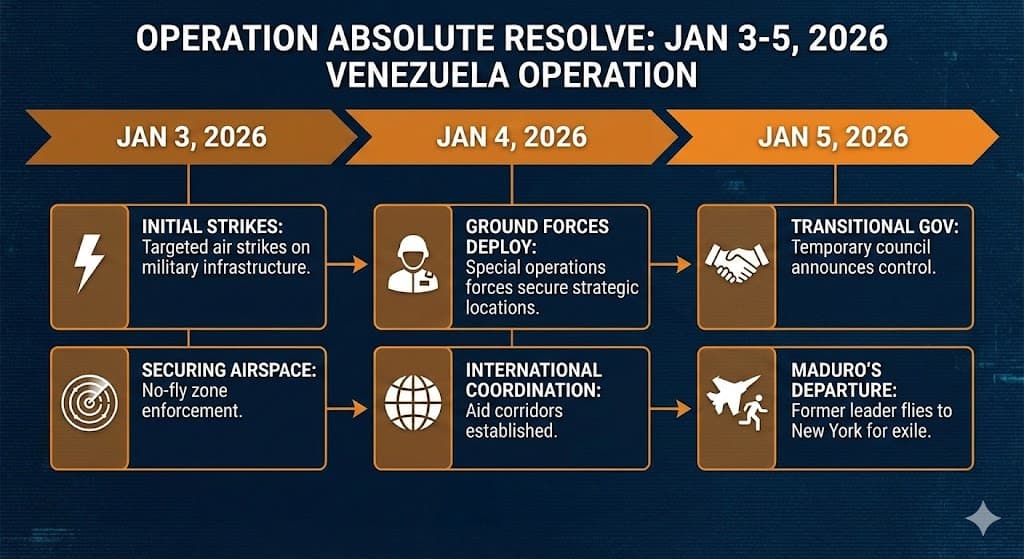
When the United States launched a military operation on January 3, 2026, to capture Venezuelan President Nicolás Maduro, it marked a dramatic turning point in American foreign policy. The operation, called Operation Absolute Resolve by Pentagon officials, involved over 150 military aircraft, Delta Force commandos, and strikes on military installations across Caracas. This event represents far more than a single law enforcement action. It reveals a long-standing pattern of American military intervention across Latin America, one consistently driven by control of natural resources rather than genuine concern for democracy.
For readers seeking to understand what happened and why it matters, this article explores the military operation itself, the historical context of US interventions in the region, and the broader implications for international law and global stability. The story of Trump's Venezuela operation cannot be told in isolation. It must be understood within the context of a century-long history of American military expansion across the Western Hemisphere.
What Actually Happened on January 3, 2026
Early morning darkness covered Caracas when American forces moved into position. Delta Force commandos rappelled from Black Hawk helicopters onto the heavily fortified presidential compound. Fighter jets screamed overhead, suppressing Venezuelan air defenses. Within hours, Nicolás Maduro and his wife, Cilia Flores, were secured and transported to USS Iwo Jima, anchored off the coast. By January 5, both had been transferred to New York to face federal charges related to narco-terrorism and drug trafficking.
The operation lasted approximately eight hours and resulted in at least 80 American casualties, along with an unknown number of Venezuelan and Cuban personnel killed in the strikes. Explosions damaged government buildings, military bases, and civilian infrastructure across the capital. The scale and intensity exceeded what most observers had anticipated for a supposedly targeted law enforcement operation.
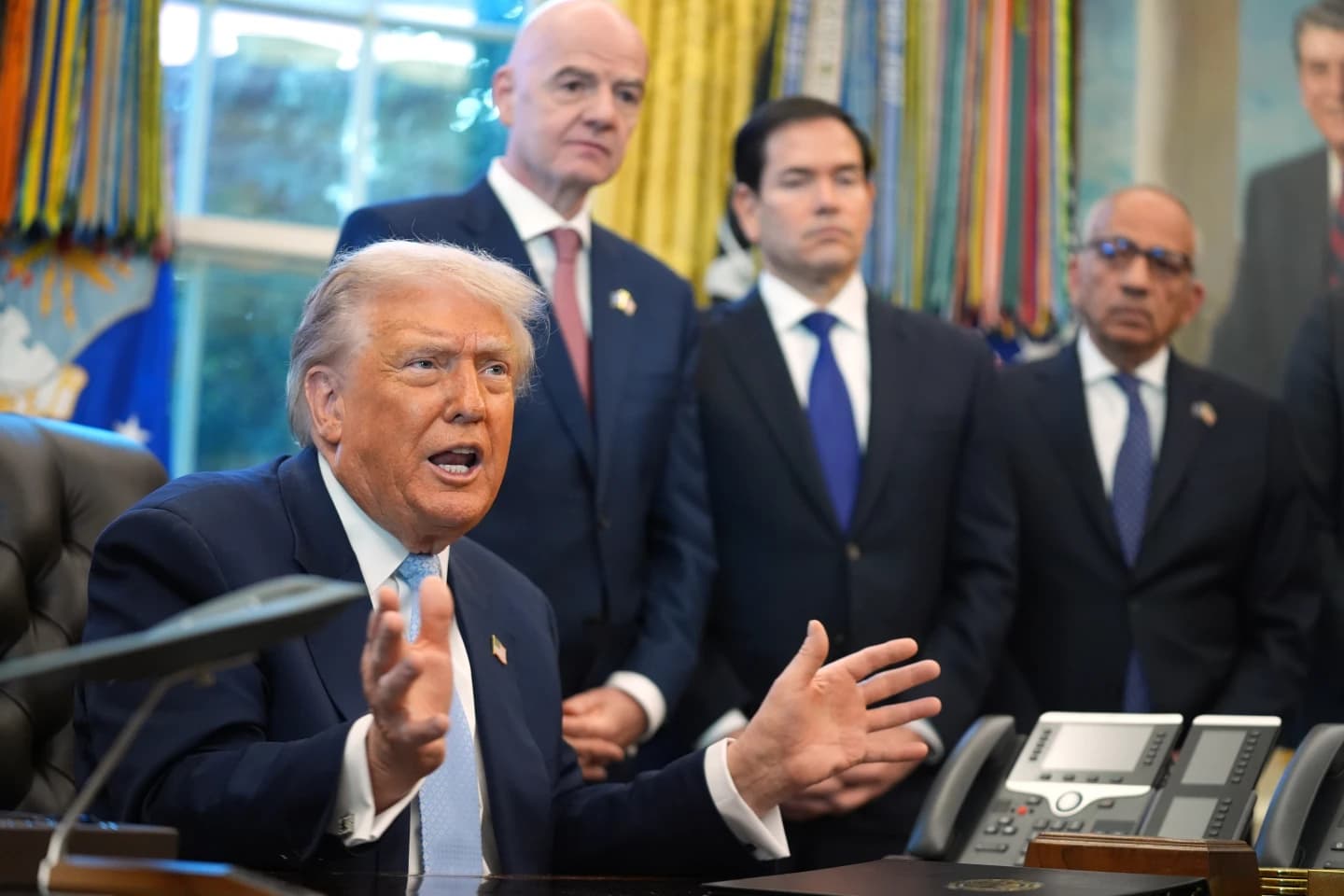
Trump announced the operation publicly just hours after it began, stating that the United States would "run" Venezuela "until such time as we can do a safe, proper and judicious transition." This announcement sent shock waves through the international community and immediately raised legal questions about American authority to govern another nation.
Why Trump Claims He Did It: The Official Story vs. Reality
The Trump administration's stated justification for military action centered on Maduro's alleged connection to drug trafficking organizations, particularly the Cartel of the Suns. Officials argued that Venezuelan military leaders, including those close to Maduro, had transformed themselves into narco-traffickers, threatening regional security and facilitating cocaine shipments to the United States.
However, Trump himself has been remarkably candid about revealing a different motivation. During his Mar-a-Lago press conference on January 3, 2026, he stated plainly that American companies would extract Venezuela's oil and that proceeds would go partially to the United States as "reimbursement" for alleged past wrongs. He referenced Venezuela's nationalizations of oil assets in 1976 and 2007, claiming the country had essentially stolen American corporate property.
This language matters significantly. When a government claims the right to extract another nation's natural resources as compensation for past business disputes, it reveals the true driver of the operation. Drug trafficking charges provided legal justification. Oil access provided the actual motivation. Trump's willingness to state this openly represents a departure from previous administrations that at least maintained the pretense that resource extraction was incidental to stated objectives.
A Century of American Military Interventions in Latin America
To understand the 2026 Venezuela operation, one must grasp the broader context of American military activity in the Western Hemisphere. What happened in Venezuela on January 3 was not unprecedented or anomalous. It was the latest chapter in a long, often brutal story of American power projection across Latin America.
The Early Period: From Monroe Doctrine to Gunboat Diplomacy
In 1823, President James Monroe announced that the Western Hemisphere was off-limits to European colonial powers. This doctrine, now called the Monroe Doctrine, paradoxically became the foundation for American dominance over the same region. For most of the 19th century, the United States lacked the military capacity to enforce hemispheric control. By the early 20th century, that changed dramatically.
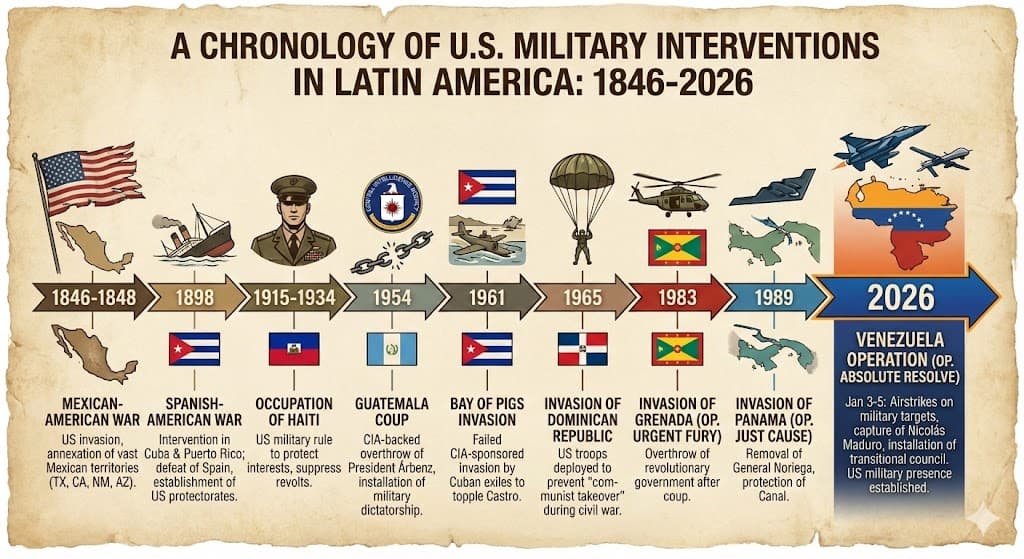
The United States invaded Mexico in 1846 under President James K. Polk, resulting in the annexation of vast territories including present-day California, Arizona, Colorado, and New Mexico. This conquest reshaped the continental map and left lasting resentment in Mexico that persists to the present day. Following the Spanish-American War of 1898, American forces occupied Cuba. The Platt Amendment, imposed on Cuba, explicitly gave the United States the right to intervene in Cuban affairs. Between 1906 and 1922, American military forces intervened in Cuba repeatedly, each time justifying the action as necessary for maintaining order while actually protecting American business interests.
Haiti experienced perhaps the harshest early American intervention. From 1915 to 1934, the United States militarily occupied Haiti, establishing pro-American governments and implementing forced labor systems that enriched American creditors while impoverishing ordinary Haitians. In Nicaragua, American military occupations lasted from 1912 to 1933, primarily driven by US desires to prevent the construction of a rival canal that might challenge American control of isthmian transit.
The pattern was consistent across all these interventions. American military power was deployed to remove or replace leaders who threatened American corporate interests or declined to maintain favorable trade arrangements. "Order" meant subservience to American economic interests. "Stability" meant suppression of nationalist movements that might assert control over local resources.
The Cold War: Communism as Cover for Resource Control
Following World War II, American intervention in Latin America continued under a new ideological banner. The Cold War struggle between capitalism and communism provided perfect rhetorical cover for interventions driven by resource control and the suppression of nationalist movements. Whenever a Latin American leader implemented land reform, nationalized resources, or tilted toward the Soviet Union, American intelligence agencies and military forces responded.
Guatemala in 1954 stands as one of the most instructive examples. Democratically elected President Jacobo Árbenz had implemented land reform affecting the vast landholdings of the United Fruit Company. The CIA, led by brothers John Foster Dulles (later Secretary of State) and Allen Dulles (later CIA Director), both of whom had represented United Fruit as lawyers, orchestrated a covert coup against Árbenz. Operation PBSuccess, as it was named, successfully removed Árbenz and installed a military government. The consequences were catastrophic. Thirty years of military dictatorship, civil war, and genocide followed. Approximately 200,000 Guatemalans were killed.
Brazil in 1964 saw similar American support for military coup that removed elected President João Goulart when he began implementing land reform and establishing ties to leftist movements. Operation Brother Sam provided logistical support to Brazilian military forces carrying out the coup. The result was a 21-year military dictatorship.
Chile in 1973 demonstrated the extent to which American agencies would go to prevent socialist governments. The CIA spent years conducting covert operations designed to prevent Salvador Allende's election. When Allende won the presidency anyway in 1970, the CIA spent an additional $8 million attempting to destabilize his government. The agency then supported General Augusto Pinochet's brutal military coup in 1973. Thousands were killed, and a 16-year dictatorship followed.
The Dominican Republic in 1965 witnessed American invasion with 42,000 troops when pro-Bosch military forces attempted to restore democratically elected president Juan Bosch. The United States cited the threat of "another Castro" and justified military occupation as necessary for regional security. The actual outcome was prevention of democratic restoration and cementing of American regional dominance.
Nicaragua from 1979 to 1990 saw the Reagan administration secretly authorize the CIA to fund and arm the Contras, right-wing guerrillas conducting a terror campaign against the democratically elected Sandinista government. Tens of thousands died in this proxy war, and Nicaragua's economy was devastated by the conflict. The US withdrawal did not restore peace but rather left a traumatized nation struggling to recover.
The common thread connecting all these interventions transcended stated reasons about communism or democracy. What united them was resource extraction, economic control, and suppression of nationalist movements challenging American corporate dominance. Whenever American business interests faced potential loss, American military and intelligence forces intervened.
Panama 1989: The Most Direct Precedent
The closest historical parallel to Trump's 2026 Venezuela operation is the December 1989 invasion of Panama under President George H.W. Bush. The parallels are instructive and revealing.
General Manuel Noriega had long served American interests as de facto dictator of Panama. The CIA had cultivated him as an intelligence asset providing information on leftist movements throughout Central America. As Noriega became increasingly involved in cocaine trafficking and posed unpredictable challenges to American control, he transformed from asset to liability.
On December 20, 1989, following the death of US Marine Lt. Robert Paz at a Panamanian military checkpoint, Bush authorized an invasion involving approximately 24,000 American troops. The stated justification was law enforcement (arresting Noriega on drug charges). In reality, it was full-scale military operation to depose the leader and install a pro-American government. The UN General Assembly voted 75-20 to condemn the invasion as violation of international law. Estimates place civilian deaths between 500 and 3,000.
Critically, the Bush administration established an ostensibly civilian government under Guillermo Endara to govern Panama after Noriega's removal. The United States provided support and maintained military presence, but civilian leadership nominally governed the country. Trump's 2026 announcement that the US would directly "run" Venezuela represents a significant escalation beyond the Panama precedent. It moves from installing a pro-American civilian government to claiming explicit American governmental authority over a sovereign nation.
Trump's "Donroe Doctrine" and Explicit Regional Dominance
Trump has rebranded his hemispheric strategy as the "Donroe Doctrine," combining his name with reference to the Monroe Doctrine. At his Mar-a-Lago press conference on January 3, 2026, Trump stated explicitly: "The Monroe Doctrine is significant, but we have far surpassed it. With new national strategy, dominance in Western hemisphere will never be questioned again."
This language explicitly abandons pretense. Trump is not claiming that American actions serve democracy or free trade or shared prosperity. He is claiming raw dominance. He also warned Colombian President Gustavo Petro to "watch his back" and suggested that "something is going to be done with Mexico." These are not the words of diplomatic engagement. They are the language of imperial power making demands of subordinate states.
Trump's discussion of Venezuela's oil revenues as compensation for past American corporate losses reveals his conceptual framework. He views Latin American resources as rightfully belonging to the United States. Nationalizations by Latin American governments are treated as theft requiring remedy. This worldview harks back to 19th-century imperialism, not 21st-century diplomacy.
The Legal Case Against the Operation: International Law Violations
International law experts virtually unanimously agree that the American military operation in Venezuela violated fundamental principles codified in the United Nations Charter. Article 2(4) explicitly prohibits "the threat or use of force against the territorial integrity or political independence of any state." The only exceptions are self-defense in response to armed attack or action authorized by the UN Security Council.
Neither exception applies to Venezuela. No armed attack against the United States originated from Venezuela. The UN Security Council never authorized military action. Therefore, the operation violated the UN Charter's core prohibition.
The Trump administration's argument that the operation merely supported law enforcement (arresting a fugitive) does not survive legal scrutiny. Military strikes on government installations, air defense systems, and military bases are not law enforcement actions. They are military operations. The scale and intensity of Operation Absolute Resolve clearly exceeded what any law enforcement action would require.
Furthermore, international law experts emphasize that if the United States sought to apprehend Maduro, the appropriate procedure was extradition through legal channels. No extradition request was made to Venezuela. No attempt was made to work through international legal mechanisms. Instead, the United States used military force to extract a foreign leader without legal process.
UN Secretary-General António Guterres stated that the operation "constitutes a dangerous precedent." Ben Saul, a UN human rights expert, declared: "The United States violated the most sacred rule of international law—the near-century old ban on use of military force against another country."
International Reactions: Overwhelmingly Critical
The global response to the Venezuela operation was remarkably unified in opposition. Brazil's President Luiz Inácio Lula da Silva condemned the invasion as reminiscent of "the darkest days of interference in the region's politics." Mexico's government warned of potential regional instability and called for respect for international law. Colombia's President Gustavo Petro denounced the operation as naked aggression against Venezuelan sovereignty.
China issued a statement declaring that the US actions "seriously violate international law and Venezuela's sovereignty." Russia condemned what it described as an "act of armed aggression against Venezuela." Cuba, Iran, Nicaragua, and other nations aligned with Venezuela issued strong condemnations.
Even some traditional American allies expressed concern. The UK's Foreign Secretary Yvette Cooper reminded Secretary of State Marco Rubio of international law obligations, though the UK did not explicitly condemn the operation. Germany's Chancellor Friedrich Merz acknowledged complexity while emphasizing respect for international law. France's Foreign Minister warned that such operations "contravene the principle of non-use of force that underlies international law."
The Dangerous Precedent: How Other Powers Will Use This
International law experts have warned extensively that Trump's Venezuela operation establishes precedent that Russia, China, and other powers will invoke to justify their own military interventions. The logic is straightforward and compelling.
If the United States can invade Venezuela to effect regime change and claim the right to govern the country, Russia can invoke the same justification for maintaining military operations in Ukraine. Russian officials have already begun making precisely this argument. The equivalence undermines any American moral authority to criticize Russian military aggression.
Similarly, China has warned that Trump's unilateral military action against Venezuela provides a blueprint for Chinese military action against Taiwan. As one strategic analysis noted, the Venezuela operation "may itself drive Moscow and Beijing to consider more aggressively pursuing their own regional territorial ambitions," signaling that "international legal constraints no longer matter and the United States has tired of its traditional alliance commitments, including those that would defend Taiwan."
The Venezuelan intervention represents fundamental challenge to the rules-based international order that, for all its flaws, has prevented great power wars for eight decades. When the most powerful military on Earth openly violates the foundational principle of the UN Charter—the prohibition on use of force against sovereign states—it signals to all other powers that might makes right.
Congressional Opposition and Constitutional Questions
Even in a Republican-controlled Senate, Trump's Venezuela operation provoked rare bipartisan opposition. On January 8, 2026, the Senate voted 52-47 to advance a war powers resolution that would limit Trump's ability to conduct further military operations in Venezuela without congressional authorization. Five Republican senators (Susan Collins, Todd Young, Josh Hawley, Rand Paul, and Lisa Murkowski) voted with all Democrats in support of the measure.
Senator Rand Paul stated bluntly: "Bombing another nation's capital and deposing their leader is an act of war, plain and simple. No provision in the Constitution grants such power to the presidency." Constitutional scholars note that the Constitution vests Congress (not the president alone) with the power to declare war. Trump's argument that secrecy was necessary to prevent operational leaks contradicts constitutional design requiring congressional involvement.
The War Powers Resolution of 1973 requires presidents to notify Congress within 48 hours of deploying military forces and limits deployments to 60 days without congressional authorization. Trump did not comply with notification requirements before the Venezuela operation. This violation raises additional constitutional questions beyond the scope of international law concerns.
Why This Intervention Falls Short Even on Its Own Terms
While Nicolás Maduro has been widely acknowledged as an authoritarian leader presiding over human rights abuses and democratic erosion in Venezuela, these facts do not justify unilateral military invasion. This principle matters because acceptance of humanitarian intervention as justification for military action opens the door to endless wars and imperial expansion.
First, military interventions for regime change have consistently failed to improve ordinary citizens' lives. Guatemala's democratic government was replaced with 30 years of military dictatorship and civil war. Brazil experienced 21 years of military rule. Chile endured 16 years of brutal dictatorship. Nicaragua suffered a decade-long proxy war killing tens of thousands. Panama's brief invasion was followed by questions about whether security or resource control had actually been the goal.
Second, the US operation does not support the candidate many nations have recognized as Venezuela's rightful leader. María Corina Machado won the 2024 Venezuelan presidential election and has been recognized by numerous countries as legitimate leader. Trump instead selected Delcy Rodríguez, Maduro's former vice president and longtime regime loyalist, to serve as interim president at US sufferance. Rodríguez, currently serving without any democratic process or popular mandate, is preferred simply because she is more cooperative regarding oil agreements and American economic control.
Third, the operation is explicitly motivated by resource extraction rather than concern for Venezuelan democracy or human rights. Trump has been remarkably candid about this motivation. Venezuela's oil will be extracted and sold, with proceeds partially going to the US as "reimbursement" for past nationalizations. This framing echoes 19th-century imperial rhetoric.
Fourth, sustained American military presence in Venezuela creates conditions for prolonged instability rather than stability. Venezuelan oil infrastructure is deteriorating due to lack of investment and sanctions. Restoration will require hundreds of billions of dollars and years of effort. US military and intelligence forces will likely provoke resistance from Venezuelan armed forces, Chinese and Russian interests, and population segments opposed to foreign control. These conditions historically create prolonged conflict rather than resolution.
Oil as the Core Motivation: The Timeline Tells the Story
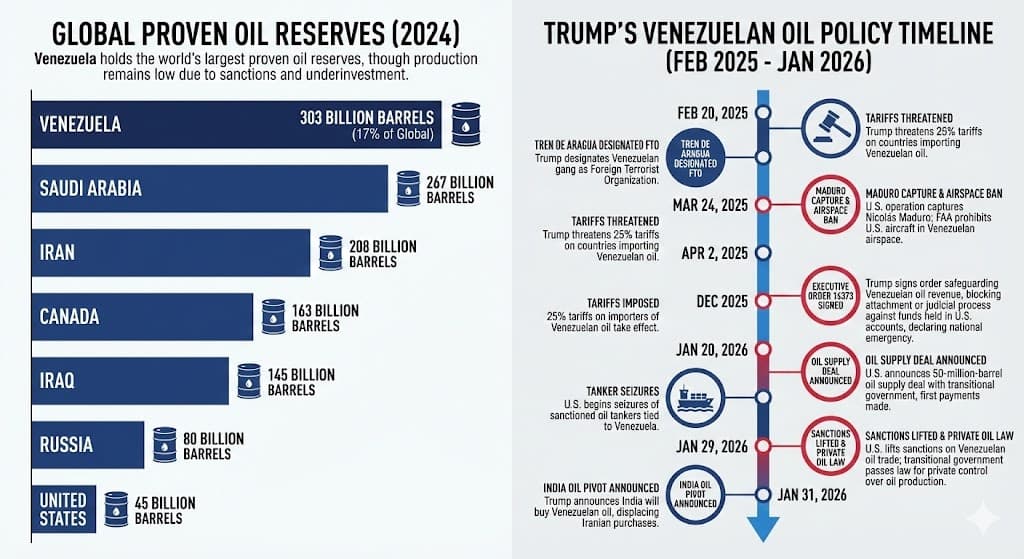
Despite rhetoric about democracy and drug trafficking, the Venezuela operation is fundamentally about oil. Trump administration officials have explicitly stated this motivation. The timeline of escalation makes clear that oil, not drugs, has been the consistent focus.
In February 2025, Trump allowed Chevron's oil license in Venezuela to lapse, cutting the US oil company out of Venezuelan production. However, by July 2025, Trump reversed course and issued a new license, signaling American interest in maintaining corporate presence in Venezuelan oil fields. In August 2025, the Pentagon began major military buildup in the Caribbean.
By September 2025, the first deadly strikes on alleged drug vessels began. The stated justification echoed subsequent rhetoric, but the geographic pattern (areas near oil-producing regions) and timing (coinciding with oil negotiations) suggest drugs were the excuse rather than motivation. By December 2025, Trump had ordered a "complete blockade" of Venezuelan oil tankers.
Throughout this period, Trump repeatedly discussed Venezuelan oil with senior advisors, particularly Secretary of State Marco Rubio, who advocated for military action. Trump's longstanding interest in accessing foreign natural resources demonstrates consistent pattern. His efforts to acquire Greenland and suggestions about controlling Panama's canal form continuous thread of resource-focused foreign policy.
Venezuela's oil is significant not merely for profits but for geopolitical positioning. Control of Venezuelan oil would reduce OPEC plus leverage, potentially drive down global oil prices (benefiting American interests), and prevent China and Russia from deepening energy partnerships with Venezuela. The operation therefore serves American strategic interests in maintaining hemispheric dominance and containing Chinese and Russian influence. These objectives have nothing to do with Venezuelan democracy or human rights.
Historical Patterns and Future Risks
The Venezuela operation represents fundamental choice about how the United States will operate in the 21st century. Will America continue operating within international law, pursuing interests through diplomacy, economic cooperation, and trade? Or will it return to explicit military dominance of the Western Hemisphere, in violation of international law and over global community objections?
Historical record provides cautionary lessons. Nations that experienced American military intervention and occupation (Vietnam, Iraq, Afghanistan, Libya) suffered decades of instability, terrorism, civil war, and humanitarian crisis. The Middle East, reshaped by American military interventions, has become an endless quagmire of conflict consuming American resources and lives.
Latin America learned similar lessons from the 20th century. American-backed coups, interventions, and military support left the region scarred by authoritarianism, inequality, and violence. Many contemporary migration crises confronting the United States in Central America, Guatemala, El Salvador, and Honduras are direct consequences of American-backed interventions and civil wars.
Trump has promised to be peacemaker and to end America's endless wars. Yet within a year of taking office, he has authorized military strikes in Syria, Nigeria, Yemen, Somalia, Iraq, and now Venezuela. The pattern suggests return to imperial presidency of early 20th century, projecting power, extracting resources, and remaking other nations according to American preferences rather than pursuing genuine peace or democratic development.
Conclusion: A Watershed Moment for Global Order
The US invasion of Venezuela and capture of Nicolás Maduro in January 2026 represents watershed moment in international relations. For nearly eight decades, the post-World War II international order has rested on principle that military force cannot be used to change borders or depose governments (except in self-defense or with UN Security Council authorization). This principle has been violated repeatedly, including by the US itself in Panama, Iraq, and Afghanistan, and by Russia in Ukraine and Georgia.
However, the Venezuela operation is the first time in the 21st century that the most powerful military on Earth has openly violated the UN Charter without any pretense of UN authorization or self-defense, explicitly claiming right to govern another nation and control its resources. This precedent will echo through great power competition. Russia has already cited it to justify Ukraine operations. China may cite it to justify action against Taiwan. Other rising powers will use it to rationalize their own regional dominance.
For Venezuelans, immediate future is uncertain. American military presence will likely ensure that Maduro remains imprisoned and that US-aligned government takes power. However, the country's economic destruction is likely to continue. Decades of sanctions, military conflict, and political instability have crippled Venezuelan institutions and infrastructure. Whether new government can rebuild remains open question, but history suggests societies destroyed by foreign military intervention require generations to recover.
For the United States, the Venezuela operation demonstrates military capability while representing dangerous escalation of imperial overreach. Bipartisan congressional opposition signals concern about trajectory. International backlash signals that the US is squandering moral authority. The precedent being set may embolden other great powers to abandon the rules-based order altogether, transforming the 21st century into an age of great power competition unrestrained by law or international norms.
The long history of American military intervention in Latin America teaches clear lesson. When American power is deployed unilaterally for resource extraction and regime change, it rarely produces stability or democracy. The Venezuela invasion represents choice to repeat these lessons despite their tragic outcomes. Whether Congress, the courts, or the electorate will constrain this trajectory remains to be seen.
FAQs
Was the US operation in Venezuela legal under international law?
No, the military strikes and forcible capture of President Maduro violated Article 2(4) of the UN Charter, which prohibits the threat or use of force against a sovereign state's territorial integrity. The Trump administration claimed it was a law enforcement action to arrest Maduro on drug charges, but the involvement of 150+ military aircraft, strikes on air defenses, and extraction of a sitting head of state clearly constituted military aggression. UN Secretary-General António Guterres called it a "dangerous precedent," and experts like Professor Milena Sterio emphasize that extradition, not invasion, is the legal path for apprehending fugitives abroad. Even US allies expressed reservations, with the UK reminding Washington of its international obligations.
Why did Trump prioritize oil access over supporting Venezuelan democracy?
Trump sidelined opposition leader María Corina Machado, who won the 2024 election and enjoys broad international recognition, in favor of Delcy Rodríguez, Maduro's former vice president. Rodríguez, a regime loyalist, now serves as interim president under US oversight because she provides "everything we need," per Trump, particularly cooperation on oil extraction. In his Mar-a-Lago press conference, Trump explicitly stated that American companies would extract Venezuelan oil, with revenues partially reimbursing the US for alleged past thefts via nationalizations in 1976 and 2007. This resource-focused approach echoes historical US interventions like Guatemala 1954, prioritizing corporate interests over democratic processes.
What historical precedent matches the 2026 Venezuela operation most closely?
The 1989 US invasion of Panama under President George H.W. Bush provides the strongest parallel. In both cases, the US cited drug trafficking charges (Noriega in 1989, Maduro in 2026) as justification for military action to capture and remove the leader. Panama involved 24,000 troops and resulted in 500-3,000 civilian deaths; it was condemned 75-20 by the UN General Assembly. However, Bush installed a pro-US civilian government (Guillermo Endara), while Trump announced direct US governance of Venezuela "until transition," representing a more overt imperial claim. Both used "law enforcement" rhetoric to mask regime change objectives.
Will the US military presence in Venezuela become a long-term occupation?
Highly likely. Trump stated the US would "run" Venezuela indefinitely pending a "safe, proper and judicious transition," with no timeline given. Historical patterns from Panama (brief but with lasting influence), Iraq, and Afghanistan show US interventions often extend years amid local resistance, infrastructure needs, and strategic interests like oil control. Venezuela's vast reserves (world's largest) require massive investment, likely tying US forces to security roles against chavistas, Cuban/Russian proxies, and potential insurgency. Congressional war powers resolutions may limit escalation but not end the current footprint.